Jesuitical Matthew GilmoreThe Contemporary RCC Attitudes Towards Blogs
Who would object?
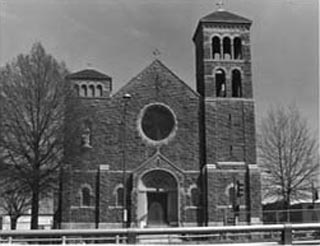
Almost everyone that I have discussed this issue with thinks it is very reasonable to relocate St. Vincent de Paul Church a few hundred feet east to sit next to a new South Capitol Mall, (especially in contrast to moving Washington D.C.’s oldest extant synagogue 4 blocks to place it next to an on ramp onto an open depressed freeway.)
But I met at least one who would object.
Mathew Gilmore.
He formerly worked at the Washingtonian Division of the D.C. Martin Luther King Library, where we made each other’s acquaintance in 1997-98 with my research of Washington D.C.’s truncated freeway network. (I would become part of a panel Freeways in Washington that was held as a part of the October 1998 conference of the DC Historical Society). Gilmore and I met in the audiences of a number of Washington DC planning related events, including at such places as the National Building Museum.


St Vincent de Paul Roman Catholic Church
Washington, D.C.
at the northeast corner of the intersection of
South Capitol and M Streets
At the December 2005 event at the Cochran Gallery, Gilmore engaged in a conversation about the matter of the St. Vincent de Paul Church/NCPC’s South Capitol Mall concept conflict. He brought up the example of the Smithsonian Institute building which sticks into the Mall. But would not that look funny, since the Smithsonian only sticks a bit into the Mall? It does not extend so far as to interrupt the West Mall to leave only enough width essentially for a West Capitol Street. What about the symmetricy too? If so, what new buildings would get constructed to face St. Vincent de Paul Church from the west I asked why not simply shift the location of St. Vincent de Paul Church a few hundred feet east to continue to sit at the northeast corner of South Capitol and M? His answer was something like “no way”, and he would absolutely refuse to even begin to say why.
Afterwards I thought the following. Perhaps a compromise was not pursued because it may have been seen as highlighting the issue: imagine all the future references about how the South Capitol Mall was designed to be interrupted by St. Vincent de Paul Church. Of course that would not explain away the existence of the South Capitol Mall proposal that appeared in NCPC’s Extending the Legacy. However, far fewer people will have seen some 10, 20, 30 40 … year old government planning document then the physical reality seen everyday. And far, far fewer people will know about that once proposed South Capitol Mall with it being conveniently unmentioned in books articles and other mass media publications and releases. That’s the beauty of blogs. They provide a venue for people to write about the things that others dare not.
However this is something that I doubt that Mathew Gilmore would agree with, given his conduct as moderator of HNet. I figured, why not let the people of the list know about what was going on with the planning of the South Capitol Street corridor, particularly the "Mall" for South Capitol that was promoted by the U.S. National Capital Planning Commission "Extending the Legacy" program, yet unreported by the lamestream news media and the "environmentalist" organizations. So I sent to his his a notification of my web site about this matter for dissemination through the list serve (as such contains a good number of people from Washington, D.C.- including those interested in the history of the city's planning).
He sent me a reply that blogs were not good and that his History list serve has a policy of not citing blogs as a rule. Say what? A simple search of the MG H list reveals this was NOT so, as Gilmore included earlier blog cites from Richard Layman’s Urban Places Urban Spaces. According to Gilmore:
Blogs are “ephemeral”
The parallel are past release of new technologies for conveying The Word. Such as the printed – typeset – press, and such things as the Gutenberg Bible. According to William Durant’s historical volume: The Reformation:
In 1456 Gutenberg, with borrowed funds, set up another press. From this he issued, in that year or the next, what has been generally considered his first type-printed book, the famous and beautiful “Gutenberg Bible” a majestic folio of 1,282 large double-columned pages. In 1462 Mainz was sacked by the troops of Adolf of Nassau; the printers fled, scattering the new art through Germany. By 1463 there were printers in Strasbourg, Cologne, Basel, Augsburg, Nuremberg, and Ulm. Guttenberg, one of the fugitives, settled in Eltville, where he resumed his printing. He struggled painfully through one financial crisis after another, until Adolf gave him (1465) a benefice yielding a protective income. Some three years later he died.
Doubtless his use of movable type would have been developed by others had he never been born; it was an obvious demand of the times; this is true of most inventions. A letter written in 1470 by Guillaume Fichet of Paris suggests how enthusiastically the invention was welcomed: “There has been discovered in Germany a wonderful new method for the production of books, and those who have mastered the art are taking it from Mainz out onto the world … The light of this discovery will spread from Germany to all parts of the earth.” But not all welcomed it. Copyists protested that printing would destroy their means of livelihood; aristocrats opposed it as a mechanical vulgarization, and feared that it would lower the value of their manuscript libraries; statesmen and clergy distrusted it as a possible vehicle of subversive ideas.
(Durant p 159)


 Mathew Gilmore’s stated attitude to me towards blogs and indeed the very issue of the conflict between St. Vincent de Paul Church and NCPC’s concept for a South Capitol Mall spurred would make me think. Why would someone into history adopt such a parochial rule that would be laughed at in hindsight? And why would someone take such a stance strictly against moving this church a few hundred feet east to accommodate the new park land keeping its historic positioning at South Capitol’s intersection on M Street SE, as if a traffic clogged 6 or 8 lane surface street with traffic lights and narrow sidewalks provides a more dignified setting then a park. Especially when Roman Catholic hierarchy has no problems demolishing church structures over the wished of the parishioners (and I have yet to see or hear any protesters demanding that St. Vincent de Paul Church should not be moved at all).
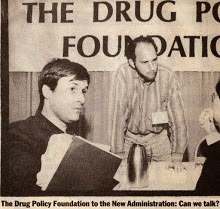
Such attitudes, and the fact that he is always dressed in black, as at Washington, D.C. events, and of course his photo on the HNet site, and that black is the mark of the clothing that mark of various Roman Catholic Church institutional orders, leads me to ask: does Mathew Gilmore belong to any such organization? Is he a Jesuit?
 That is an organization with the mission of serving the Roman Catholic Church; that’s its best known mission. Less known is that this includes undermining protestant and independent thought? This is the sort of shit that would explain why our educational system blinks when it would come to teach the history of Europe throughout the 2 centuries leading up to our own 1776-1783 American war for independence: that is the Reformation and the Counter-reformation.
The Jesuits have a tradition of concern regarding the spread of the written word; from pp 923-924 of William Durant's The Reformation:
At various times the popes ordered the burning of the Talmud or other Jewish books. Wycliffe and later Protestant translations of the Bible were forbidden, as containing anti-Catholic prefaces, notes, and emendations.. Printing heightened the anxiety of the church to keep he members uncorrupted by false doctrines. The Fifth Council of the Lateran (1516) ordered that henceforth, no books should be printed without ecclesiastical examination and consent. Secular authorities issued their own prohibitions on unlicensed publications: the Venetian Senate in 1508, the Diet of Worms ad the edicts of Charles V and Francis I in 1521, the Parliament of Paris in 1542; and in 1543 Charles V extended the ecclesiastical control of publications to Spanish America. The first general index of condemned books was issued by the Sorbonne in 1544; the first Italian list by the Inquisition in 1545.
In 1559 Paul IV published the first papal Index auctorum et librorum prohibitorum (List of things Prohibited). It named forty-eight heretical editions of the Bible, and put sixty-one printers and publishers under the ban. No book that had been published since 1519 without bearing the names of the author and the printer a and the place and date of publication was to be read by any Catholics; and hereafter no book was to be read that had not ordained an ecclesiastical imprimatur – “let it be printed.” Booksellers and scholars complained that these measures would handicap and ruin them, but Paul insisted on full obedience. In Rome, Bologna, Naples, Milan, Florence, and Venice thousands of books were burned – 10,000 in Venice in a day. After Pauls’ death leading churchman criticized his measures as too drastic and indiscriminant. The Council of Trent rejected his Index, and issued a more orderly proscription, the “Tridentine Index” of 1564. A special Congregation of the Index was formed in 1571 to revise and republish the list periodically.
p 924
The censorship of books was laxly enforced until Paul IV entrusted it to the Inquisition (1555). That institution, first established in 1217 [at the time of the suppression and massacres of the Catharians], had lapsed in power and repute under the lenience of the Renaissance popes. But when the final attempt at reconciliation with the Protestants had failed at Ratisboon, and Protestant doctrines appeared in Italy itself, even among the clergy, and entire towns like Lucca and Modena threatened to go Protestant, Cardinal Giovanni Caraffa, Ignatius Loyola and Charles V joined in urging the restoration of the Inquisition. Paul III yielded (1542), appointed Caraffa and five other cardinals to reorganize the institution and empowered them to delegate their authority to specific ecclesiastics throughout ‘Christendom’. Caraffa proceeded with his accustomed severity, set up headquarters and a prison, and laid down rules for his subordinates.
1. When the faith is in question, there must be no delay, but on the slightest suspicion rigorous measures must be taken with all speed,
2. No consideration is to be shown to any prince or prelate, however high his station.
3. Extreme severity is rather to be exercised against those who attempt to shield themselves under the protection of any potentate. Only he who makes plenary confession should be treated with gentleness and fatherly compassion.
4. No man must debase himself by showing toleration toward heretics of any kind, above all towards Calvinists.
Paul II and Marcellus II restrained Caraffa’s ardor, and reserved the right of pardon on appeal. Julius III was too lackadaisical to interfere with Caraffa, and several heretics were burned in Rome during his pontificate. In 1550 the new Inquisition ordered the trial of any Catholic clergyman who did not preach against Protestantism. When Caraffa himself became Paul IV, the institution was set in full motion, and under his “superhuman rigor,” said Cardinal Seripando, “the Inquisition acquired such a reputation that from no other judgment seat upon earth were more horrible and fearful sentences to be expected.’ …
Is this supposed to be good?
What business does someone favoring censorship have being a gatekeeper of historical information?
And we wonder why so many people are uneducated about the reformation, the counter reformation, and of course the continuing counter reformation.
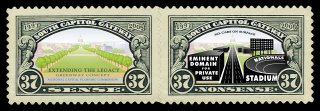

 June 2005, Looking East-Northeast
  Feb 11, 2007, Looking East-Northeast


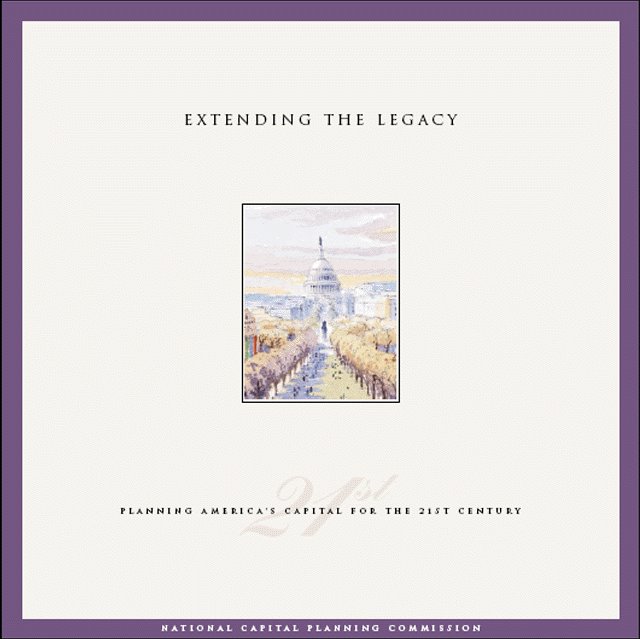 Cover: U.S. NCPC's 1997
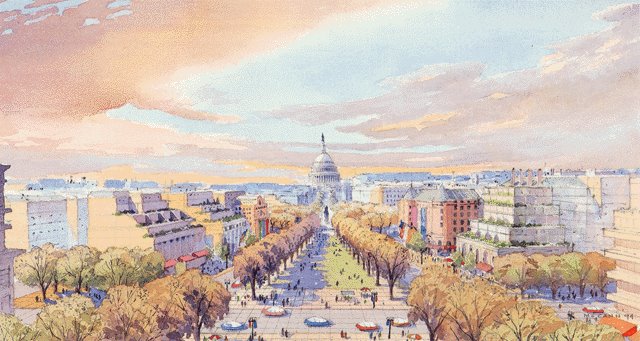 South Capitol Mall at M Street
 South Capitol Mall at the Anacostia River
 Peter Hans Kolvenbach


 "W" Stadium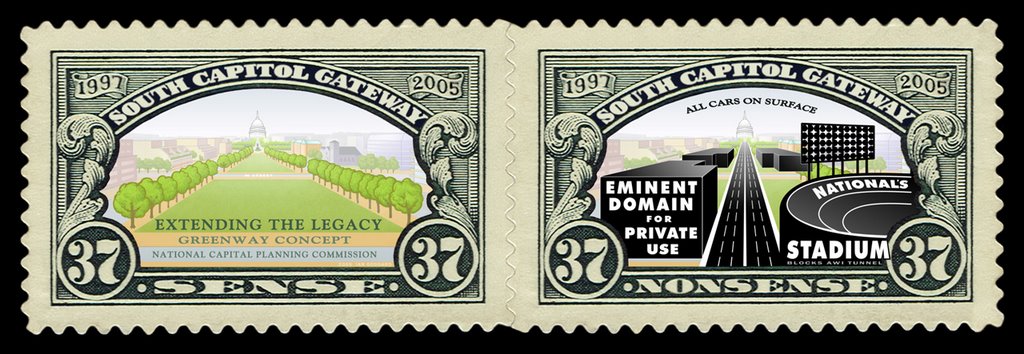


 A poster allegedly from the poor building's point of view.